Hilary

I will hold the Christ-light for you

in the night-time of your fear

I will hold my hand out to you

speak the peace you long to hear

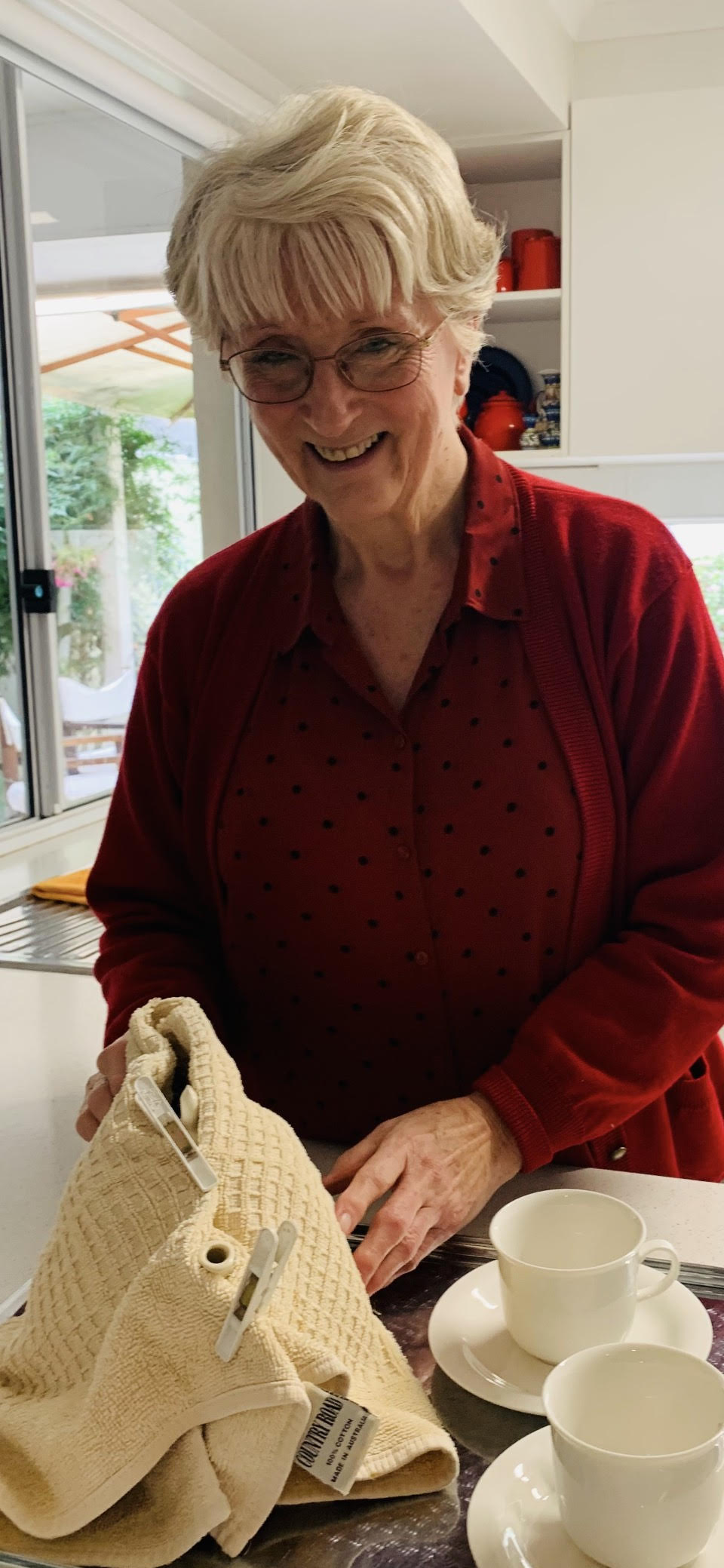
The second last time I saw Hilary she made me tea. She poured the hot water into an elegant white ceramic pot, selected two bone china teacups, and placed them on a tray. Then she suddenly darted into the laundry. She came out with an old hand-towel and two pegs, and proceeded to create the most ridiculous-looking tea-cosy I’d ever seen.

I laughed and she laughed at my laughing, and agreed to pose for a photo with her quizzical creation. I had no idea, at that time, that it would be the last photo I’d ever take of her. 

It was funny because Hilary was the most tea-cosy-like person I knew. Her home was like an extension of her; beautiful, tasteful, comforting, sometimes surprising. It was a home that was comfortable with itself; modest, yet luxurious at the same time. She didn’t have clutter, although the house always felt full. A bowl of deep red cherries always sat temptingly on her white counter in front of the garden window. Bunches of super colourful flowers were everywhere; in her hallway, in the living room and through the house. It was some time before I realised she had found good quality plastic ones – which, of course, was easier than having to get them fresh all the time. Through long years of trial and error, she had discovered the best way to do things. Sometimes through a lot of patience and pain. And prayer, I suppose.

Hilary was the vicar at St James Anglican Church, Pakenham, when I arrived there as a fragile fifteen year old. In her 60s, she seemed like a harmless nice old lady to me when I first met her. She lilted away gently at her sermons in her sing-song Welsh accent. She delivered the liturgy with quietness and humility and grace. Yet she looked you straight in the eye when she handed you the wafer for communion and there was something in the way she said “the body of Christ, given for you” that made me feel like maybe it really was. My Dad says the day she won his respect was the time she led us in the Lord’s Prayer and then stopped, looked at us all and said “I just realised I said that without really meaning it. Do you mind if we all say it again?”

As I got to know her better, I learned that Hilary was a quiet radical. Someone who had worked long and hard to have her own house in order. Someone who actually believed what she said she believed. She became a female vicar in a time when women were discriminated against in church leadership. When she was appointed to St James, I was told that half the church left because she had suffered the pain of divorce in her personal life. She was an Anglican priest and yet she was primarily a woman who was in love with Jesus. She was drawn to where the Spirit of God was moving. About twenty years ago she travelled to Bethel and on missions in South America and encountered the power of the Holy Spirit to speak in tongues, to heal the sick, to cast out demons. She came back to St James to share the ways in which she had discovered God was bigger and more confusing than we’d previously known. And yet she didn’t push it on people. I remember her running optional ‘soaking sessions’ after the traditional services. I remember, as a teenager, watching curiously as the adults lay on the floor between the pews, basking in the transcendent presence of God, while the kids silently helped themselves to the church biscuits.

—-

I visited Hilary’s house many times over the years. In the last few years, I’d go every second Monday for lunch, and enter in to the smell of some keto casserole she’d been cooking for me. I would spend hours with her, crying and praying and drinking tea – nestled up in her warm lounge room or sitting outside on her patio. Her garden was strictly succulents – because they were easier to maintain. But she grew them somewhat obsessively, constantly propagating more in there greenhouse and frequently giving them away. 

The garden was themed white and cream and green, with that one yellow flower that she couldn’t bear to get rid of. It felt calming and homely and beautiful all at the same time. And it was always clean. That was the thing that surprised me most – just how well she managed to keep everything. All of the colourful stone eggs in the bowl perfectly dusted, the cream tiles of her courtyard always swept, the eggshell-blue living-room carpets always fluffy. She was the kind of person who washed her windows – who laundered and dried her curtains every Spring. 

This is why it was hilarious to me that Hilary didn’t have a tea-cosy, but instead used an old towel held together with pegs on her beautiful tea pot. “I will get you a tea cosy!” I declared, quietly resolving to knit her one for Christmas. After all, it would be a fitting, if small, token of the love I had for someone who had been a spiritual mother to me. On that day neither of us had any idea, as we picked up the tray and brought it out into her garden, that her body was fighting cancer, that she had just over six months to live.

—-

The last time I saw Hilary was just before my big operation. My cancer had grown back and they were going to cut out a key section of my bowel, leaving me with a permanent colostomy. I sat in her cream garden chairs and used up her tissues as I wept out my sorrow, my disappointment, my rage, my confusion with God, and my seeming inability to pray. 

She sat there, with me, as she always did. I don’t remember much of what she said. I honestly don’t remember much of what she said over the many years and many hours of crying with her in this way. When I came back from Vietnam as an 18 year old who had lost faith in God. As a 24 year old who was unsure if I was going to be able to go ahead with my wedding. As a 32 year old who had just been told she could have months to live. What I remember is her presence, sitting with me in the pain, seeing me. Feeling my pain and yet not being overcome by it. Hilary had the amazing capacity and uncommon grace, as someone who had been through great pain, to re-enter it, with another – to hold onto them with one hand and to remain holding onto God with the other. When you are in that place, sometimes, you cannot reach out of it, but you can hold the hand of someone else who is willing to reach back in. 

On that last day, which we didn’t know was the last day, she went into her study and came back with a wooden cross. “It’s OK” she said “that you cannot pray”. She had ministered to many people in the season of transition through death and she had a collection of these wooden crosses that felt smooth and comfortable in your hand. The wood, she said, came from olive trees from Jerusalem. The kind that could have been in Gethsemane. She invited me to choose a cross, anointed it with oil and prayed a blessing over it and over me. “When you cannot pray”, she said “hold this, and God will understand.” 

Prayer suddenly felt possible again. I took it with me into the hospital. The nurses put it in a plastic bag so I could take it into theatre. It was sitting next to me on my bedside when I woke up in the ward. 

___

As the days passed in hospital my body became strong again quickly. I regained the ability to get out of bed, to stand, and then to walk. I was doing surprisingly well and feeling a sense of optimism about being able to survive. 

As I prepared to leave the ward to go home, I discovered the man in the room two doors down from me was being discharged also, but he was being sent home to die. With some reluctance but also conviction, I wrote a card and wedged the wooden cross uncomfortably inside the envelope, asking his daughter to deliver it to him if she felt it would be of any comfort. Hilary would approve of this, I figured. The hope of Christ was given to us to give away. And the next time I saw her, I’d ask her for another one.

What I didn’t realise was, at the time that my body was getting stronger and stronger, Hilary’s was beginning to give way. She waited to tell me because she knew it would hit me hard. 

A few weeks after I got home from hospital, when she had already checked with  Mum to be sure I was doing well, she called me to tell me that she had been diagnosed with cancer. She was at peace, she told me, and the Drs believed it was curable. I didn’t want to think about it. I couldn’t think about it. Instead, I kept recovering. I got busy. A few months passed and I texted her to say I was thinking of her, knowing that she would invite me to visit when she was well enough. She replied that her chemo was going well and would soon be finished. Life kept hurtling on. I was teaching again, as she had always believed that I would.  

A couple of months later Mum and Dad were over for lunch. They told me she ‘wasn’t doing so well’. It took a week for me to push through the denial and text her about a catch up. A few days later, I got a response from her son saying it was too late. 

And that’s how quickly it happened. That’s how quickly I lost one of the people who have had the most profound impact on my life. Tomorrow is her funeral. 

I never knitted her the tea cosy. I was too focused on my own pain. I never asked for another cross. I was too focused on my own busyness. I never took the chance to say goodbye. I was too much in denial.

And yet, I am not wrecked with regret, with shame, or with despair. I have too many moments of experiencing grace. Somehow, the lightness that Hilary always brought to me in life is palpable even in the moments of her death – her faith and her hope linger on sweetly, even in her memory. 

I am weeping, and I am in shock, and the loss is overwhelming. And yet, a candle flickers somewhere in the night-time of my heart. A peace has been spoken there that does not waver. 

And I am grateful for Hilary -to have known her in this world, to be loved by her, and to love her still. 
Shoots of Green

(Written in May 2024)

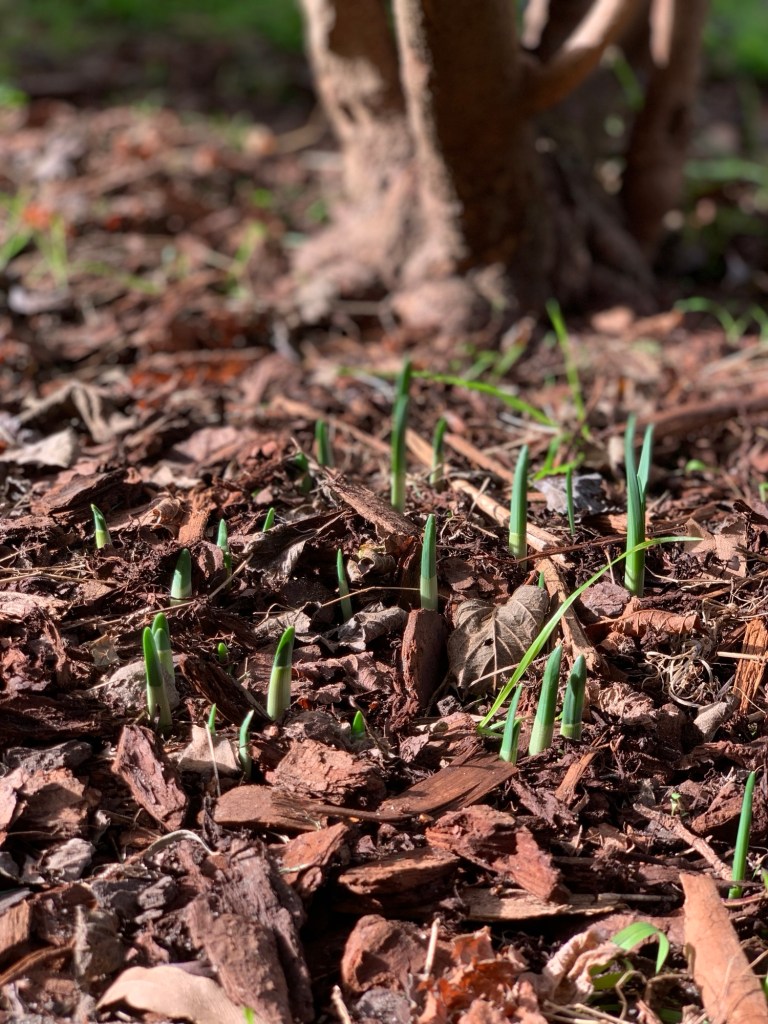
Each year, I find, it surprises me that the bulbs begin to shoot up, even before the start of winter. My parents come from the Northern Hemisphere, and so much of my understanding of ‘normal’ is therefore displaced from the world I actually live and grew up in. Bulbs are supposed to come up at the end of winter, I always believed. They are the first herald of Spring. But somehow, in our milder Antipodean winters, the dear things seem to get confused and pop up early. 

It is always a shock to notice that the seasons change so methodically- like birthdays- like my menstrual cycle- they keep happening whether we are ready for them or obliviously distracted. I am never quite ready for winter. I fear it – the winter blues- I fear who I become inside of myself in winter. Something inside of me was made for beauty and sunlight, and the cold mornings and the dark nights make it harder to ignore the wounds inside my soul. And so I find myself, like a child (or a teacher!) dreading the end of the summer holidays, kind of trying to ignore it, kind of subconsciously denying that winter is, indeed, coming. 

But, as the years go by, I find myself increasingly ministered to by the bulbs in my garden. And, as I sip my coffee from my prayer bench this morning, I find my eyes overflowing with gratitude for the little spears of green.

I was seven when Grandad passed away from cancer, and was living half a world away. My mum, I remember, was away for weeks. And she was very sad. I was distressed too about one particular question – was Grandad in heaven now? Mum told me that Grandad had not known Jesus during his lifetime. But we serve the God of second chances and ridiculous overflowing grace -the God who told the parable of the workers in the vineyard, who told the thief on the cross that they would be together in paradise. We are loved to pieces by the God of resurrection. Mum told me she had shared this with grandad in the days before he died- in the days where he was no longer able to talk. And, although he hadn’t been able to do much, he had squeezed her hand. 

I remember when Mum came back from Britain, she bought a special brooch of a golden daffodil that she wore on the lapel of her jacket for a long time. Daffodils, she told me, are a symbol of resurrection. We plant the dry dead-looking bulbs deep in the cold earth at the start of autumn, burying them as we bury our mortal bodies at death. And beneath the earth, in the places that we cannot see them, they start to come alive. Slowly, surely, in that place of deepest cold and dark, life is reborn. Until suddenly, sharp ramparts of green spear boldly through the ground, like an army of life assembling. And then the flowers come, trumpeting loudly their resurrection glory- their triumph over Winter – and the herald of Spring. 

I think that one of my first interactions with daffodils was at my grandad’s grave. I remember walking through the graveyard by the Loch where Grandad is buried and standing for a moment before his grave – that place, which my ten year old self had been afraid to approach because of my fear of the sense of desolation. And there were daffodils in bloom. They were great tall rollicking things- a triumphant blast of yellow against the dark grey headstone. And I allowed myself to become enveloped in the glorious yellow-ness of them for a moment that was like a prayer – a prayer where Jesus was talking gently to my heart in words of colour. Death, he was saying, was not the end. In the very place that we think death has won- that is the place of resurrection. 

It turns out that Mum’s brooch was not a coincidence. Daffodils are the symbol of the cancer council, and, as I walk through my own journey with cancer, this could not be more prophetic. Somewhere deep within my heart, twenty four years ago, an encounter with the yellow-ness of daffodils and I believe, also, with the God of hope, fused in me the connection: daffodils and resurrection. And so, even as I think of the sadness of my grandad’s death, the anxiety of the approaching dark and cold, the unknowns of my own journey with cancer, a part of my heart is brimming with the hope of resurrection. And as I look delightedly around me I find, in His grace, God has sent me daffodils-  even before the start of winter.

Waiting for the Dawn

The thing is, I’ve never really lived in a world without the sun. True, I have definitely lived (and am living in) a time of night. The sun is not showing its face. The earth is cold. I cannot see what is happening. I am rendered powerless. And sometimes I cry and lament and grieve the sun that I remember. Sometimes I wonder if it is – or ever was – real. All I can touch is cold and dark and shrouded, all I hope for is lost in blackness, my horizon disappeared. Every minute I turn my face towards the East, hoping, watching, waiting. Darkness seems to assault me again and again. And again. 

Surely, I say to myself, it was just a dream! Those who hope in the sun are delusional. Can they not see the blackness around them? Are they not willing to acknowledge that their world has shrunk down to the tiny radius around them – the wonders of the day have been lost, and, no matter how hard we try or hope or even believe, we cannot seem to make it come.

And many of us have now given up on the hope of day. It has been too long. No one we know has ever seen a sunrise. It is but a fairytale we tell to children. In the long, cold, darkness, we have learnt to make our own small versions of the sun – lighting candles, and even campfires. We huddle around them like moths, singing songs of worship to the candlelight, YOLOing like cicadas who know we will not live to see the dawn. These, we guard, because our lives depend upon them. Until some cold wind comes and extinguishes them. 

And sometimes in the darkness I find myself able to sing songs about the sun. Sometimes I talk to others who believe that the dawn is coming, who believe in the existence of day. Some of these are those who are holding candles and some, like me, have lost them. Some have even cast them aside willingly, in preparation and expectation of living by daylight. Sometimes, I hold hands with them, joining my trembling heart to their stronger ones, and I recite verses that promise the end of the darkness, as salty rivers run down my cheek and neck. Sometimes, something inside of me inexplicably lights up and I feel, somehow, that I am bathed in sunlight.

And then sometimes I wake from this reverie, overwhelmed by the reality of the darkness, stunned by the pain of it, and I fall to the ground in despair. I declare that the sun has never been. I have hoped and prayed and sung about the dawn, and it has not come. The darkness has only encroached farther, become even darker. And, screaming visceral shrieks of fury and betrayal, I claw at the carpet and weep bitterly. And I curse the sun.

And yet, the thing is, I’ve never really lived in a world without the sun. As I am hoping, singing, praying, weeping -even cursing – the sun itself is the centrifugal force upon which my whole world turns. I cannot see it. I cannot sense it, but sometimes, I am willing admit that it is there, creating a gravitational pull that keeps this whole planet in orbit. Despite the coldness of the night, despite the waves of abandonment that crash over me, it is the sun that keeps the ground from freezing over. Although hidden from my view, a part of me is willing to believe it burns continuously, giving energy to every plant and underwater organism that creates oxygen that allows me to breathe. And my lungs, whether they are singing or whether they are screaming, are swallowing air that has been made possible by the sun.

And my hope, my belief, my cajoling, my despair does not affect the way the sun moves, does not change it – because it is not dependant upon me.  How humbling, how painful, how freeing to realise this! As much as I love or I hate it, as much as I protest or scream, whether or not I can see it, the sun has been and will be the source of all the life I’ve ever known. And, sometimes, I allow myself to be brought to my knees. I admit that I am not the source, that the sun is the centre. I acknowledge that, although my candle is gone, although I cannot see the path ahead, that the ground all around me is not frozen, that the air I breathe continues to support life in my lungs, that it is possible that a sunrise, which I have never seen, and do not control, is coming. 

And I place my hands in the hands of others who also wait with hope for the end of the darkness. And we turn our heads towards the inky blackness of the East. And we wait for the dawn. 

Good Friday World

We are living in a Good Friday world. This is not a comfortable fact. This is not something we want to admit. This is the vast chasm of screaming brokenness that we spend our lives teetering desperately away from. Dreams. Health. Career. Success. Family. Living your best life. We brandish these things like weapons, like armour against the fact that we are mortal and, as one of my friends puts it, ‘the world is on fire’. 

Sure, we realise that bad things do happen, but they happen, mostly, to ‘other people’ – those poor souls out there who are living in Gaza, or the Ukraine, or central Africa. We, in the developed world, are able to generally live our lives insulated from the cries of the desperate and the dying. We craft a delusional bubble of immortality and immunity and we work hard to protect it for as long as we can. 

There are a few things that scare us – car crashes, terrorist attacks, and cancer – the only conceivable tragedies that could touch us in our insulated lives, but we console ourselves that this won’t happen to us. It’s very unlikely. And we plan to start actually going to the gym.

And yet, despite our illusion, we are being eaten away slowly from the inside. Our buried brokenness rises up slowly, encroaching on us like the very cancer we seek to avoid. But we don’t want to realise how far we are from reality, how far we are from seeing our vulnerability, our desperation, our need for a saviour. 

This is the case, even, for those who call themselves ‘Christians’ – at least it was for me. I was happy to be a Christian insofar as it meant getting a ticket to heaven and maybe even following most of the rules, but was I interested in taking up my cross to follow Jesus to death and resurrection? If I’m honest, not at all. 

It’s actually kind of crazy hard-core; the ravaging brokenness of the reality of this world, the utter desperation in which we find ourselves, the intense passion of our Saviour – and what he asks of us in return. It feels too big. Too much. Too scary. Like I thought life was a Rom Com and I’ve woken up in ‘Lord of the Rings’. How can I possibly take part in this adventure? 

In church this morning, I slipped off my reeboks and knelt on the hard carpet between the rows of seats. It was all I could do – to offer my body, to open my hands. The weightiness of the presence was in the room and I was desperate to be close, to breath him in. As I knelt there, I was transported to the foot of the cross. One of the women who knew and loved Jesus, weeping, as her Lord was splayed helpless across wooden beams and broken in front of her. Pain. Anger. Confusion. Despair. Jesus – you were supposed to save me! You were supposed to stop the cancer from ever occurring in my body. You were supposed to heal the bowel tumour before my last colonoscopy! There is so much you were supposed to do! And there you are – silenced and broken, apparently impotent and shackled, yourself overwhelmed by the pain of this world. I do not understand. And yet, you are still my Lord. 

Somehow, I manage to lift my eyes from the ground to the cross above me. For an infinitesimal and unexpected moment, his face turns and his eyes lock with mine. 

And He sees me. 

Real Death and Real Resurrection

Well the last few weeks have been some of the hardest of my life. I got told a couple of weeks ago that my bowel tumour is growing. There are a lot of reasons that is bad that I don’t feel like going into here, but it’s bad. They want to do a big operation on me in a couple of weeks but they can’t promise anything from it, apart from the fact that it would give me a permanent colostomy – which would be the first big hit my body would have taken in this whole journey.

And I have been kind of lost. Lost in a swirl of panic and pain. There are lots of questions and not really any answers. There are lots of reasons to doubt and fear. There are lots of reasons to remonstrate and self-blame. Almost every fibre of my being is grasping for a vestige of control. My body has been in an almost constant state of fight or flight, which is only helped with running or sauna or binge-watching ‘Young Sheldon’ on Netflix (seriously – it’s the cutest show!).

Or I can come into His presence. If I can bear to confront the depths of my anger and pain and bring it, along with my heart, into the secret place. I can come to a place of really deep self-emptying, maybe for a couple of minutes. I can come to a place, for a short time, where I let go. Where I have cried out the last drops of my own resistance and laid open my heart’s deepest anguish. Then, sometimes, I find I can hide in that space in the shadow of his wing.

The death he calls us to is real. I don’t think I had got that. I don’t think I wanted to get that. I still don’t.

I think all of us, really, read John 3:16 and interpret it as “for God so loved the world that he sent his only Son to die so we would never have to taste death”. Nope. Turns out he wants us to die to ourselves. And he says it too: “all who are obsessed with with being secure in life will lose it all – including their lives. But those who let go of their lives and surrender them to me will discover true life”. I think perhaps we should make that the new John 3:16 – print it on bookmarks or Christian mugs or something.

And so we go around in this sort of Christian half-life, quite content to stay here – in this life that we have now – and hope that God blesses it. We sing “you can have all this world, give me Jesus” and then we go home and expect God to work around our plans for our lives. At least that’s what I have always done.

I was standing at the front of the room in worship at church today, surrounded by people declaring that “I don’t need anything else, you are my one thing” to Jesus, and I was telling him that I sure as hell didn’t feel that way. I want to live in this world. I want to live ‘my life’. The desire is strong. The sense of it being my right is strong. But I can see that all my sense of fight and entitlement is also empty and useless to actually save me. I see, terrifyingly, my ultimate helplessness in the face of death and disease and disaster. I realise that I cannot control this world, cannot even control my own body. The brokenness of this world seems to be attacking me from the inside – my very cells turning rogue.

And I am starting to learn how to let go. Not to ‘give up’ but to ‘give upwards’. Somehow, I really do believe he wants life for me – and life abundantly. Somehow, I really do believe he has a plan. And I have no idea what this is going to look like.

I’ve been resisting surrender. I’m still resisting it. I don’t want it. And that’s part of the point. Jesus didn’t want to let go at Gethsemane. We wrestle alongside him. We take up our cross, alongside him. We die alongside him, and alongside him we are resurrected. This is the mystery of faith – perhaps a faith I never wanted. A story I would never have volunteered to be a part of. But He’s told us all along; our only hope for both this world and the next is in living resurrection. And you cannot have real resurrection without real death.

None of this makes sense. But to whom else would I turn?

Give me Jesus.

Love

And so we come to the final week of Advent – the week where the focus is love. It seems appropriate that this week happens at the time where we are catapulted into the chaos of family and high stakes festivities. Where expectations and needs and understandings of reality clash and clang like swords in combat. Where love seems anything but simple.

Due to a dastardly case of covid, my family will be celebrating Christmas almost a week late this year. For the first time in my life I didn’t spend Christmas day with my parents. We didn’t do our Christmas traditions. And the pain and requirements and expectations and needs associated with that loss chucked up a whole new set of questions about what love looks like for me. In real life, love seems a lot messier than on Christmas cards.

I think I have been dreading the week where the focus is on love because, the older I get, the more I realise I don’t really do it as well as I thought. ‘Love’ is something we talk about constantly. We use the word (especially if we are a female millennial) almost incessantly. And there are many examples of ‘love’ in our world. What a mother holds for her child is certainly love. So is the feeling the child has towards her mother. And yet how many mothers are truly whole enough to love in ways that leave no scars? How many children have a love where they are not the centrifugal force about which their parents turn? And then there’s romantic love, which is surely the icing on the cake, and yet, once you start digging a bit deeper, I often wonder how many of us confuse ‘being in love’ with the feeling of being loved ourselves.

There is a phenomenon, that my husband likes to dryly remind me of, in which your confidence in your own authority on a topic decreases in inverse proportion to your actual expertise on the matter. It happens because the more you know, the more you realise there is to know. I think it’s a bit like that with love. I think, the more I learn about the human heart (and the more I learn about my heart, in particular), the more I see I need to learn. Although I was lucky enough to be brought up in a family where I was loved and have friends who loved me and marry a man who loves me faithfully, my heart has managed to become wounded and broken and separated from love in so many many ways. And sometimes, when I look at God, I feel no love at all.

God says they are ‘love’. I have to admit that I honestly do not know what this means. The concept of continuous and joyous self-emptying being the very nature of the godhead fascinates me – and is one that I find very difficult to grasp. If the very nature of God is self-emptying goodness, then why this mess? Why doesn’t she/he do what is screamingly self-evident to any human who looks upon the brokenness around us? Or is the answer truly in the holiday we are celebrating? How does a baby in a manger fix all of this?

It would be dishonest to say I haven’t felt a sense of God’s love at all, though. I have had moments of feeling it – like sunshine on my back. It’s not like something you see fully in front of you – more like a diamond that you can only see one face of at a time. I’ve felt moments of it – of unexpected affection or delight. Moments of release and exultation. I’ve felt peace and a sense of being front and centre of their gaze. And yet those moments seem to be the exception, not the rule. My heart quickly retreats into its self-imposed prison – of bitterness and lowered expectations, of unforgiveness and victimhood, of disappointment and self-protective grasping.

I think I’m more likely to have felt God’s love through people who seem to know them. These are the people who make me think that God must be alright and, if I could only know the Jesus they know, I would truly love him. I’ve experienced a lot of love through people these past two years. Love will sit and listen to my pain. Love will fast with me. Love will forgo eating carbs when he is around me. Love will hold my hand at every single appointment. Or pay for a hot air balloon ride for me. Love will offer to have my baby for me, even if she doesn’t yet know what that really entails. Love will walk in my front door and empty my dishwasher. Again. Love will say ‘it’s OK’ when I arrive late for a catch up. Again. Love will offer me their beach house. Love will go surfing with me, just to let me feel the joy of the waves. Love will come and mow my lawn and start digging out the dandelions. Love will pick up the phone. Again.

There has been a lot of commentary on the insufficiency of the English word for ‘love’ and the various types of love. I suspect that there are more than four or ten or twenty different types of love. Perhaps ‘love’ is more like the concept of ‘colour’ – and there are a hundred thousand different variations and intensities and flavours, but it saturates everything and everything is flavoured by the love soaking into it. Or maybe love is more like the light that bounces off the colours – revealing the true nature of the objects and textures in the world – the requirement for everything to be.

The more I learn about it, the more I realise my heart is dry and thirsty, and perhaps hasn’t given away as much of it as I think. Perhaps learning to love is like learning to speak, and we are all infants who are still babbling. Perhaps this is OK – the babbling stage being an important one as we slowly learn to use our vocal chords and eventually progress to using one or two words.

Joy

Those of you who are extraordinarily observant, may have noticed that I skipped out on writing a blog on the week of advent devoted to ‘peace’. This was not intentional. I really wanted to write one. I wanted to hold myself up as an example of someone who lived a life surrendered in hope and trust and therefore was able to live in the promised ‘peace beyond understanding’. But, right now, that is simply just not true. Peace is something that has largely eluded me for the past while – perhaps four months – as I wrestle and agonise over the decision about whether or not to go ahead with an aggressive and controversial set of surgeries. And, at the end of all of my specialist appointments and conflicting advice, I find myself no closer to an answer than at the beginning.

No, peace has not been something I have been able to access in this season – even though I did truly feel gifted with peace for a large part of the last year. It is linked to something deep and very raw that is still very much in process. Perhaps, one day, I will be able to write about it.

But for now, I will leave peace and focus instead on joy. Joy, strangely, has not been something to elude me in this season. There is a depth and a wonderfulness to joy that I have, truly, been able to access, at times. Like a draught of strong port wine. Or a river I can immerse myself in and be carried along by. Joy comes to me from Outside. It is not something I have to drum up within me. It is an alive thing – an entity – a movement that is going on all around me, and it is inviting us to join.

I have felt moments of almost excruciating joy in the midst of this nuclear rain. Honestly.

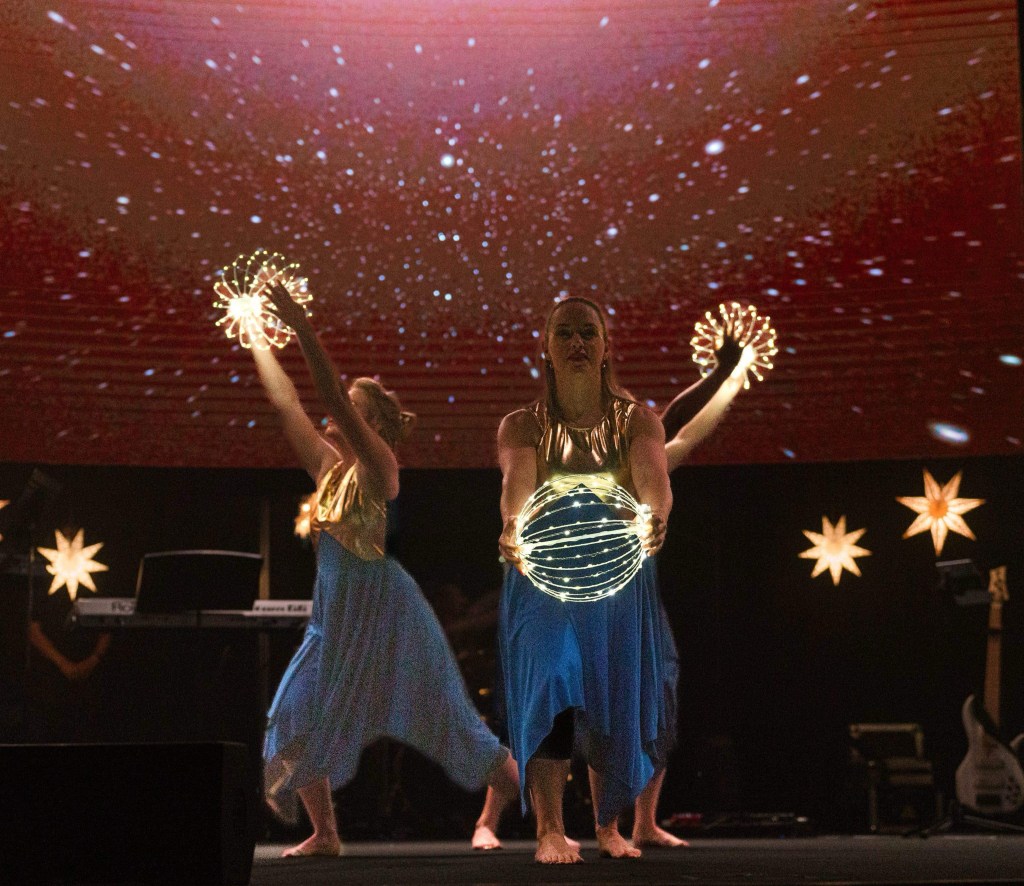
I am starting to learn that joy is not an emotion; it is a parallel dimension. It is a place somewhere outside of our space-time continuum, where the victory has already been won, the story has already been resolved, where it is finished. And it is a dance -the eternal victory song of heaven which is being danced right now. And we get to join in with it. It’s a very strange thing. There is literally a celebration of the culmination and completion and redemption of all things – a party – happening in some realm of the spirit that, sometimes, I can connect to. And the celebration is real. It is a place where the wounds of this life have already been healed, the sting of bitterness or regret is not even a memory. Where cancer is just something we laugh at and wonder how we could possibly have been afraid. The relief – the explosion of relief, and delight, and adoration comes in wave after never-ending wave. And sometimes, I surrender my heart to it, diving in, allowing the current to take me and swirl me into this place where death cannot touch me – or even cast a shadow. Where all I sense is this energy of LIFE pulsing through my body and, as I jump and leap try to twirl it out of me, it only grows.

And then, when I crash-land back into the strangeness of my reality, I wonder how I could have possibly accessed this place of joy. Am I crazy? Dissociative? Delusional? Or is there a real world of the spirit that has beckoned and welcomed me, has caught me up in his arms and danced with me, saturating my heart with delight and wonder?

And, as I think about this experience of joy, I am open to the idea that, perhaps I am not crazy. Perhaps my moments in this space of rejoicing are the moments when I am truly awake to reality – the ‘deeper magic’ that C.S. Lewis refers to in Narnia. Perhaps the pain and abuse and betrayal of this world is the delusion and this dance of joy is an innate language that my spirit was always meant to speak. Perhaps, there truly is a parallel universe where all is very, very well.

And then, sometimes, I have a very ordinary – or worse than ordinary – day in this very broken universe. But even as I look at the starkness of the landscape of ‘facts’ and scan reports around me, my heart remembers something of the dance. And the memory both nourishes me and increases my longing.

The Wisdom of Surfers

Here I am, drawn away again to the sea, sitting on a blustery coastal beach, watching a pod of young surfers.

Ignoring the signs declaring ‘dangerous beach’ and prohibiting swimming due to ‘strong currents’, they gaggle delightedly down the stairs, throwing clothes to the side and jumping into their wetsuits. Full of the yelp and bluster of being fourteen, they sprint haphazardly towards the beach – hardly able to contain their joy, their hunger, for the ocean. They gallop and canter across the sand, pausing at an obliging sandhill to try their hand at surfing down the dune. Carelessly, they throw their bodies and boards down the cliff of sand, again and again and even again – tussling like puppies at play.

Suddenly, one of them tires of the sandhill and turns towards the sea. The others instinctively follow. Running gleefully towards the rip, they throw themselves into it, one after another after another. They fight against the tide to get into the deep, paddling with frantic excitement into the mouth of the churning maelstrom. SMASH! They feel the majesty of the ocean, sense its awesome power. Exhilarated, they fling themselves into its chaos.

Bobbing up and down, they respond with long-practised skill to each wave as it comes. The glassy blue speedhumps, they allow themselves to slide over. Occasionally, with the small crests of foam, they let themselves be picked up and tossed lightly backwards. And then the massive fists of ocean power roar right up to them. I watch, breathless as, kneeling on their boards, they arch their backs like little black caterpillars and plunge their heads beneath the breaking foam. My heart skips a beat as they are lost in the swirling torrent. Then, a long second later, they rise – almost balletically – like the little Mermaid on the rock, before shaking the water vigorously from their salty manes.

And they keep riding the rip out, deeper and deeper, til they get to the place where the really big waves are crashing – the ones whose roar and thunder sends pulses of fear and awe through my body, even as I sit safely on the shore. And then, somehow, in the heartbeat of a second, they have turned on their boards, and I gasp as I realise they are hoping to catch this one – to fling themselves completely at its mercy.

There is a moment when they are shrouded in a blizzard of crashing whiteness. The arc and body of the waves completely covers them, and I think they’re lost in its terrifying, seething, mass. But then, they emerge, a tiny black dot amidst the snowstorm of spray, hurtling forward with all the speed and majesty of the ocean. Completely surrendered to its power. Pulsing forward.

And I wonder at the strange wisdom that these reckless kids have found. The wisdom of knowing how not to fight the ocean. Of accepting, even embracing their smallness. The wisdom of becoming immersed, submitting themselves to each peak and trough, each wipeout. The strange interplay between agency and surrender. The acceptance of the ocean’s uncontrollability – even the delight in it. How they dance so playfully when they are so completely beyond their depth, in the midst of something they absolutely cannot control.

The Land of ‘At Least’: A Scrambled Eggs Tragedy

Here I am again. At the beach. At a cafe. At the start of a blank page. Hoping to write words of saintly inspiration, of resilient hope, of eternal significance. And, instead, I am all churned up because of an argument about scrambled eggs.

As I survey the menu at this beautiful beach-side cafe, I realise I again have to ask to get modifications for my anti-cancer diet. I love bread. I love flavour. I love going out for delicious food, and it is one of many losses that I experience in my new existence with cancer. It has been hard to adjust to a life without carbs, without comfort food, without the nurturing embrace of fresh baking. 

Different cafes have different approaches to you when you ask for modifications. Today, I feel sorry for myself for having cancer and having to eat keto. I don’t have the emotional energy for extended negotiations, so I deploy the silver bullet and use the ‘cancer card’ pre-emptively.  I try to sound light-hearted about it but I’m not sure that I fool anyone.

I suppose the first red light should have been the apologetic uncertainty of the waitress. Both waitresses. The first one used the excuse that she was new and had to check. The second one nervously explained they don’t usually ‘do modifications’ and that I’d have to pay extra. The price was already $24. Without toast, potatoes, or bacon, but with a bit of added spinach, I’d end up paying more like $29. More money for much less food. And I was already stressed about the cost of going out for breakfast. My sense of abandonment was whirlpooling. I revved up and pushed back further. ‘So I’d have to pay extra to have less, then?’ She went again to check with the manager. Finally, yes they can do it. 

With an ingratiating smile, I thank the manager as he brings out my coffee. There is no smile in return. He explains that he doesn’t like to do modifications because he’s already worked out the costs of ingredients. And I see that he is also a victim.

Ah’, I say, suddenly ashamed. Did he want me to pay the extra? ‘No, no,’ he mutters, disgrunteldly. I’d won the victim game.

And as I sit down and pretend to be OK, the fruit of my Pyrrhic victory churning uneasily in my gut, I consider the way that the undertow of victimhood swirls uneasily like a riptide beneath the surface of our normal days, pulling us unconsciously sideways. To some degree, everyone living in this broken universe is living in the land of ‘at least’. You don’t have a partner but at least you can go on amazing holidays. You can’t get pregnant but at least you can focus on your career. You can’t afford to start paying off the credit card but at least you can raise the price of scrambled eggs. You are told you have ‘terminal cancer’ but at least you can go out for breakfast.

And we walk around with these flags of ‘at least’ flying invisibly above our heads, daring anyone to challenge our victimhood. Daring anyone to assert that our needs don’t matter. Like wounded dogs, nursing our pain, ready to pounce on the unwitting perpetrators of any further injustice. 

And I deflate slowly as realise how far I am from the reality of the Kingdom. And I remember the invitation I have been hearing to step out of living in ‘the land of at least’. The land of limitations. The land of lack. We live as paupers – as orphans, dejected, rejected, and used to scraping and scrapping for the smallest slice of bread. Or in my case, spinach. 

And I feel the call to be living in a different reality. He says he has come to give us life in abundance. Dripping with abundance. Dripping. And it doesn’t really matter whether we are struggling to make ends meet or worrying about our career or scared about our very life. These are all just limitations on a scale that pales in comparison to the Creator who is the Source of Everything. We can’t really get our heads around it. 

And how? How do I live outside the ‘land of at least’? How do I become aware and transformed by His place of complete enoughness? I don’t think I can approach this place alone. I think it requires revelation. I think perhaps I will go and sit by the sea, which I didn’t create and cannot earn. And try to pry open my grasping, anxious, heart to what He is offering.